News

U.S. Air Force Logo United States Air Force

332nd ELRS conducts first hot-pit refuel with R-20 expeditionary refueling system

  • Published Jan. 5, 2026
  • By Airman 1st Class Jonah Bliss
  • United States Air Forces Central Public Affairs
U.S. CENTRAL COMMAND AREA OF RESPONSIBILITY (AFNS) --  

For the first time at this location, U.S. Airmen assigned to the 332nd Expeditionary Logistics Readiness Squadron conducted a hot-pit refueling operation using an R-20 expeditionary refueling system to support a U.S. Army UH-60 Black Hawk helicopter on a flightline within the U.S. Central Command area of responsibility, Dec. 14, significantly reducing aircraft ground time and expanding expeditionary fueling capabilities.

The operation marked the first use of the R-20 at the base to conduct hot-pit refueling, allowing the helicopter to remain running while taking fuel directly from a bulk fuel bladder rather than a standard R-11 fuel truck. The capability enables faster turnaround times, conserves limited refueling assets and improves mission responsiveness in a deployed environment.

“Basically, it allows us to pump straight from the fuel bladder into the aircraft without having to worry about using an R-11,” said Staff Sgt. John Kaelin, 332nd ELRS fuels distribution noncommissioned officer in charge. “If we had to send one or two R-11s out here, it would take away resources we need to support all of our other aircraft.”

U.S. Air Force Airman 1st Class Samuel Ilet, 332nd Expeditionary Logistics Readiness Squadron fuels distribution operator, moves a fuel hose into position in the U.S. Central Command area of responsibility, Dec. 14, 2025.

U.S. Air Force Airman 1st Class Samuel Ilet, 332nd Expeditionary Logistics Readiness Squadron fuels distribution operator, moves a fuel hose into position in the U.S. Central Command area of responsibility, Dec. 14, 2025. Ilet was preparing to refuel a U.S. Army UH-60 Black Hawk helicopter using an R-20 expeditionary refueling system during the unit’s first hot-pit operation with the equipment at the deployed location. (U.S. Air Force photo by Airman 1st Class Jonah Bliss)

Photo Details / Download Hi-Res
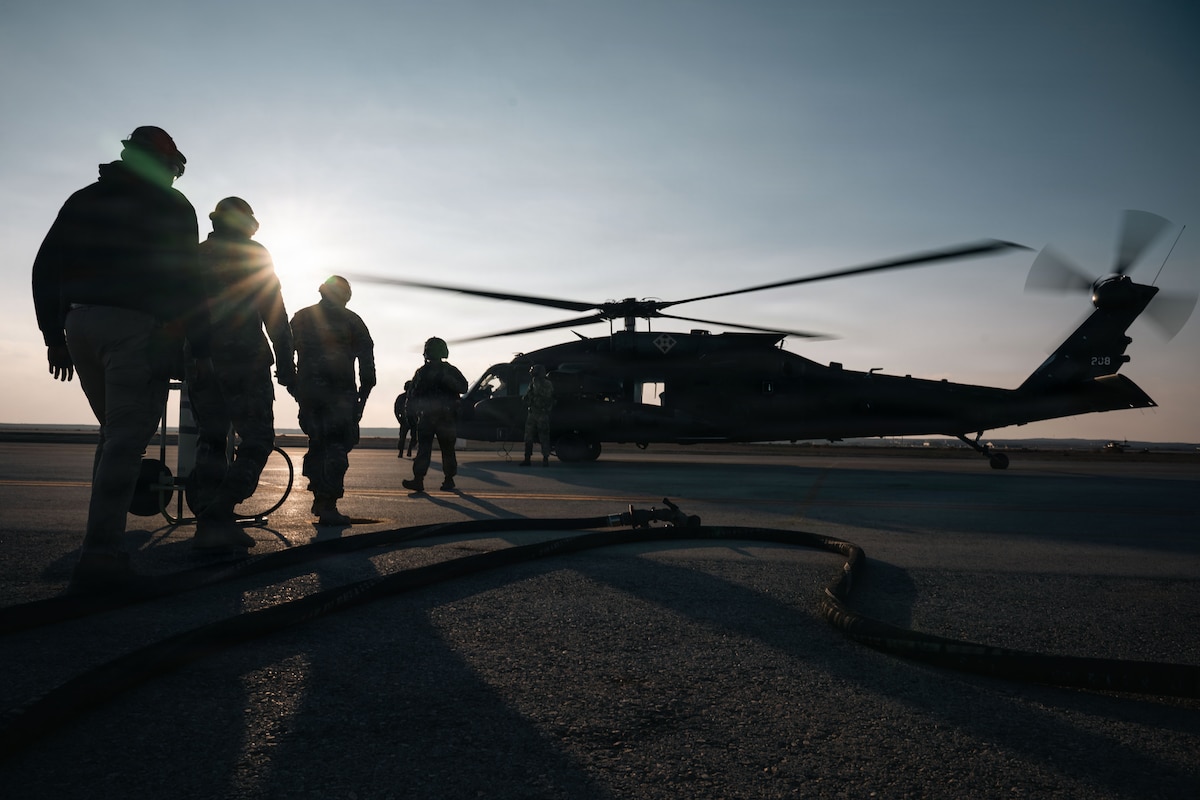
U.S. Air Force Airmen with the 332nd Air Expeditionary Wing prepare to refuel a U.S. Army UH-60 Black Hawk Helicopter in the U.S. Central Command area of responsibility Dec. 14, 2025.

U.S. Air Force Airmen with the 332nd Air Expeditionary Wing prepare to refuel a U.S. Army UH-60 Black Hawk Helicopter in the U.S. Central Command area of responsibility Dec. 14, 2025. The team used an R-20 expeditionary refueling system during the unit’s first hot-pit operation with the equipment at the deployed location. (U.S. Air Force photo by Airman 1st Class Jonah Bliss)

Photo Details / Download Hi-Res
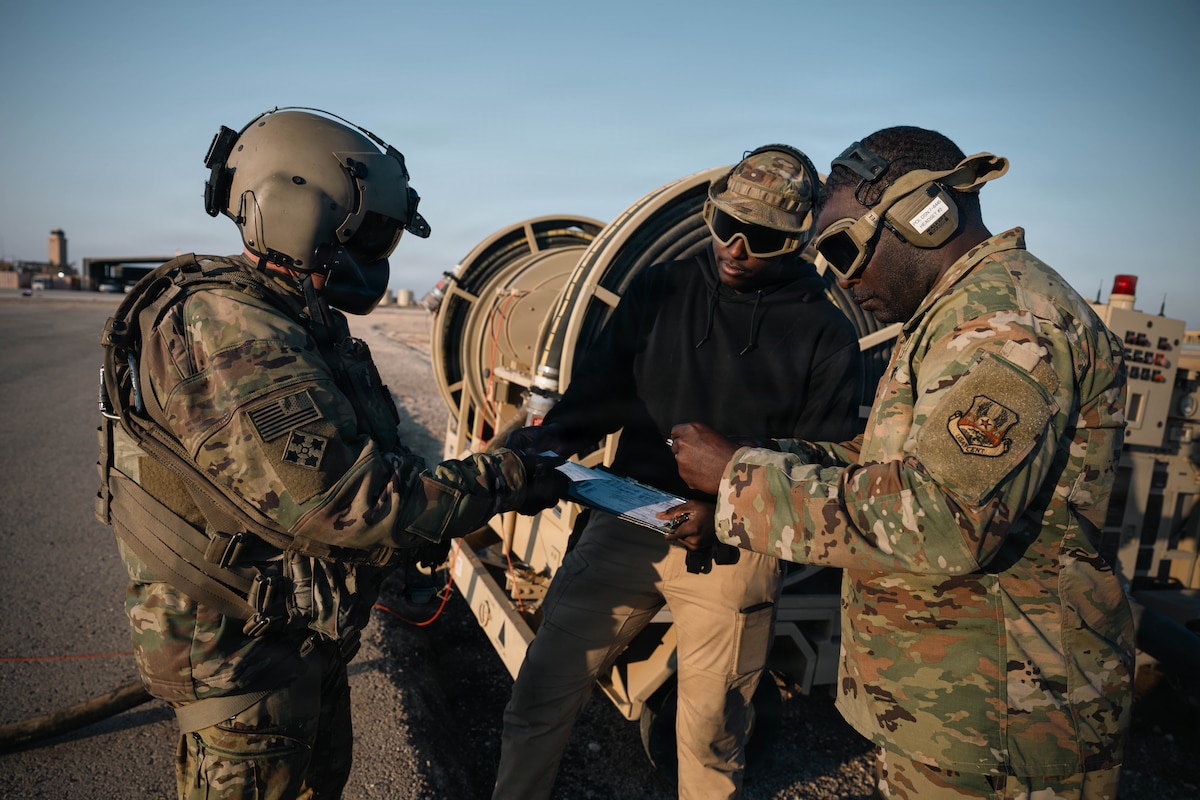
U.S. Air Force Chief Master Sgt. Nicholas Jackson, 332nd Expeditionary Air Base Group senior enlisted leader, right, and Airman 1st Class Samuel Ilet, 332nd Expeditionary Logistics Readiness Squadron fuels distribution operator, center, complete refueling documentation for a U.S. Army aircrew member in the U.S. Central Command area of responsibility, Dec. 14, 2025.

U.S. Air Force Chief Master Sgt. Nicholas Jackson, 332nd Expeditionary Air Base Group senior enlisted leader, right, and Airman 1st Class Samuel Ilet, 332nd Expeditionary Logistics Readiness Squadron fuels distribution operator, center, complete refueling documentation for a U.S. Army aircrew member in the U.S. Central Command area of responsibility, Dec. 14, 2025. Accurate refueling records allow Airmen to efficiently manage fuel and maintain aircraft readiness across the flightline. (U.S. Air Force photo by Airman 1st Class Jonah Bliss)e photo by Airman 1st Class Jonah Bliss)

Photo Details / Download Hi-Res

Kaelin explained that traditional cold refueling for UH-60 helicopters can take up to 75 minutes, including shutdown procedures and system checks. Using the R-20 for hot-pit refueling reduces ground time by 66% and allows aircrews to return to the air faster.

“In a deployed setting, the longer it takes for them to get back out, the longer whoever they’re going to help is waiting on them,” Kaelin said.

The R-20 also provides significantly greater fueling capacity and flexibility than the R-11. Each R-20 hose can issue fuel at a rate of up to 450 gallons per minute, with dual-hose operations capable of delivering up to 900 gallons per minute. Unlike the R-11, which carries a maximum of 6,000 gallons, the R-20 connects directly to bulk fuel bladders capable of holding more than 200,000 gallons, enabling multiple aircraft to be refueled simultaneously.

“Here we can hit two aircraft at a time, depending on size, and keep the mission going if we need to get sorties in the air,” said Airman 1st Class Samuel Ilet, 332nd ELRS fuels distribution operator. “Deployed, you never know when something could pop off, and they have to go up as soon as possible.”

The successful R-20 hot-pit refueling demonstrated the squadron’s ability to rapidly adapt expeditionary fuel operations, ensuring aircraft can launch faster, respond sooner and remain ready when mission demands are at their highest.

U.S. Air Force Logo

Lethality readiness AF Air Force USAF AFCENT U.S. Air Forces Central 332nd ELRS Hot pit refuel R-20 expeditionary refueling system Army UH-60 Black Hawk U.S. Central Command USCENTCOM
Department of the Air Force Logo